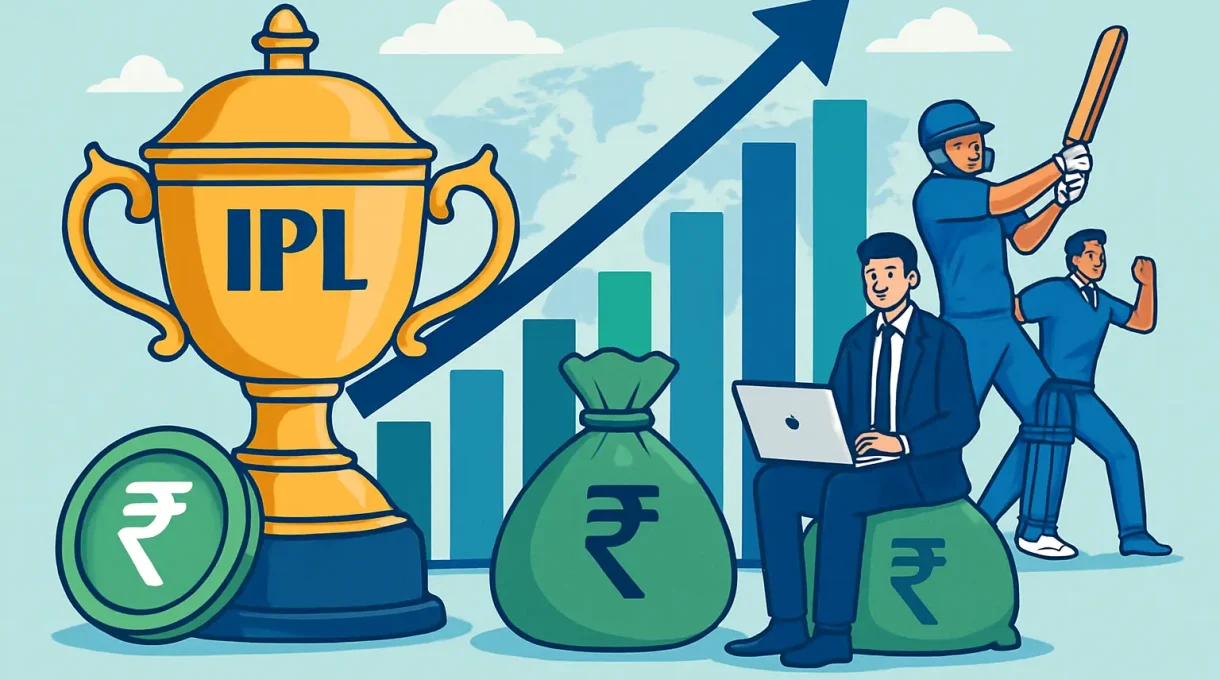
A single number sits at the center of the league’s business story: the IPL brand is now a double‑digit‑billion asset in US dollars, and a multi‑lakh‑crore behemoth in rupees. Taking the most recent independent valuation studies and cross‑checking with franchise transactions, current media contracts, and sponsor disclosures, a practical headline is this: the IPL brand value clusters around USD 11 billion, while the total economic value of the IPL ecosystem — league plus ten teams — sits in a broad USD 12–15 billion range. In rupees, that translates to roughly ₹1.0–1.2 lakh crore for the wider ecosystem, give or take currency swings and methodology differences.
Those are not vanity numbers. They show up in cash flows every season, driven by a media rights deal that rewired the market, a title sponsorship suite that sets the tone for brand India each summer, and ten franchises that have built sticky fan communities out of cricket passion, city pride, and product consistency. Strip away the hashtags and celebratory confetti, and you still have a franchise entertainment machine that throws off serious, recurring cash.
Note on currency: all INR-to-USD conversions here use a notional rate of ₹83 per USD and are rounded. Actual exchange rates fluctuate and can move reported USD figures up or down without any underlying change in rupee economics.
What “IPL Net Worth” Means in practice
Net worth in sport is often used loosely. Clarity matters.
- League brand value is an intangible valuation of the IPL brand itself. It reflects awareness, loyalty, favorability, and the power to generate premium cash flows across media, sponsorships, and licensing.
- Enterprise value of the ecosystem refers to the combined economic value of the league and its franchises, taking into account expected future cash flows and the market multiples applied to comparable sports assets.
- Franchise valuation reflects each team’s enterprise value, not the owners’ personal wealth. Brand value for a team is different from its enterprise value; the former is a component of the latter.
When readers ask about “IPL net worth,” they typically want all three: the league’s brand value headline, the combined value of the ten teams, and a practical sense of what makes those numbers move.
Headline snapshot: valuation, media money, and scale
- IPL brand value sits around USD 11 billion (₹9.1 lakh crore is not the right conversion for brand value; brand value is stated in USD — in rupees, think high tens of thousands of crores as a directional sense, though brand value is not meant to be directly converted like enterprise value).
- Combined franchise enterprise value in USD terms stretches from low tens of billions when aggregated, with individual teams ranging from roughly USD 0.7–1.5 billion each, depending on brand strength, city economics, and on‑field story arcs.
- Media rights remain the backbone. The current cycle’s total contract value is approximately ₹48,390 crore across packages, with per‑match value north of ₹100 crore. Digital and television both write large cheques, and the hard pivot to mass‑reach free streaming has supercharged sponsorship demand and data‑driven inventory packaging.
- Central sponsorships provide the second pillar. Title sponsorship alone contributes a large, predictable chunk each season, with associate partners and on‑ground categories layering significant upside. Aggregate central sponsorship collections have reached mid‑thousands of crores across the season when you combine title, on‑air, on‑ground, and category exclusivities.
- Attendance and ticketing are climbing again, helped by venue upgrades, corporate hospitality, and the occasional blockbuster gate at the world’s largest cricket stadium. Seven home games per team plus playoffs means tens of millions of paid seats per season when stadiums run hot.
A simple valuation model you can trust
Forget the jargon for a moment. Here’s the plain‑English way analysts triangulate IPL valuation.
- Start with cash. Add up central media revenue, central sponsorships, and other league‑level income. Then estimate franchise‑level revenue: central distribution share, local sponsorships, ticketing and hospitality, licensing and merchandising, and small lines like events or content deals.
- Subtract the big costs. Franchise player salaries within the cap, support staff and cricket operations, stadium rentals and match‑day ops, academy and grassroots programs, brand and marketing, and — in the case of the two expansion teams — a fixed annual franchise fee paid to the board as part of their ownership bids. At the league level, stage production, broadcast operations, event management, and administration sit here.
- Forecast growth. Media rights escalate within cycles and jump at renewals. Sponsorship yield increases as ratings hold and digital targeting improves. Ticket pricing gains from hospitality. An analyst will build a three‑to‑five‑season cash‑flow ramp with conservative growth on mature lines and higher growth on digital and pricing.
- Discount or apply multiples. Discounted cash flow yields a present value. A multiples cross‑check uses comps like EV/Revenue from other top cricket boards and global leagues. Premium assets often trade in the high single to low double digits on EV/Revenue; the IPL’s risk profile and growth cadence justify the upper band.
The shape of that math, not any single input, underpins the headline IPL brand value and the range of franchise valuations you see cited by financial media and valuation firms.
Media rights power the engine
The single biggest driver of IPL valuation remains the broadcast and digital rights. The current cycle set multiple records: a total pot near ₹48,390 crore for the multi‑season package, a per‑match value comfortably above ₹100 crore, and a meaningful split between television and digital. Two realities flow from that outcome.
- Competition created durable price discovery. With major broadcasters and a streaming heavyweight bidding, the per‑match price reset to a level commensurate with top‑tier global properties. That anchored franchise valuations higher, because central distributions scale with rights money.
- Digital unlocked a new growth corridor. Free‑to‑user streaming with hyper‑targeted advertising created audience and data at a scale advertisers crave. Categories that once bought television alone now allocate incremental budgets for connected TV, mobile, and interactivity. The sponsorship stack is increasingly sold with digital measurements and branded content built into the inventory.
Analysts track three levers through a rights cycle: average minute audience and total reach, ad yield, and distribution monetization. When reach rises while CPMs hold or climb, central sponsorships typically grow in tandem. That flies straight into the valuation model.
Central sponsorships: the second pillar of league economics
Title sponsors pay a premium to wrap the season narrative with their brand identity. The current title sponsor has committed a multi‑season sum that sits around the ₹500–700 crore per‑season mark by public reporting, with the full suite valued higher when bundled benefits are counted. Associate partners — think on‑Air, on‑Ground, Strategic Time‑Out, Umpire/Official partners, ball partners — add several hundred crores collectively.
This income is not only large; it is stable. These are multi‑season contracts with rate cards indexed to reach, and they signal to other advertisers what the association is worth. In practical terms, central sponsorships can equal or exceed the total local sponsorships of all but the richest franchises. For valuation modeling, they provide predictability similar to media rights, just with more negotiation and activation complexity.
Revenue sharing: who keeps what
The IPL’s distribution architecture leans toward a balanced, franchise‑friendly split while preserving the board’s investment and risk coverage.
- Central pool composed of media rights and central sponsorships is split roughly half to the board and half to franchises, with a small carve‑out for prize money and certain expenses. Exact percentages fluctuate with contract structures and taxes, but the directional share is a genuine partnership model.
- The franchises’ pool is typically distributed equally among teams. That means the smallest‑market team and the largest‑market team start with the same central cheque each season, before local revenues and costs determine true profitability.
- Legacy franchises generally pay a lower fixed fee to the board now than they did in their formative years, when some models mandated a percentage of revenue. Expansion franchises uniquely pay a fixed annual fee linked to their winning bid for an initial period, which materially affects their early‑stage P&L even when revenues are strong.
The practical effect: central distributions in a typical season can range in the ₹350–500 crore band per franchise, depending on the structuring of the central pool and deductions. That base funding explains why even mid‑table teams can be financially healthy as long as local commercialization is competent and costs are kept in check.
Team valuations: latest table and ranges
These values reflect a blend of public reporting by valuation firms, transaction whispers, sponsorship comparables, and market intelligence. They are expressed as indicative enterprise value ranges rather than single‑point estimates, because methodologies differ and currency moves can distort USD figures overnight.
Team valuation table (indicative)
| Team | Range | Momentum | Why |
|---|---|---|---|
| Mumbai Indians (MI) | USD 1.3–1.6 billion | ₹10,800–13,300 crore | rising | trophies, Reliance ecosystem, Mumbai market, deep sponsor bench, multi‑club strategy across T20 leagues |
| Chennai Super Kings (CSK) | USD 1.2–1.5 billion | ₹9,900–12,400 crore | rising | legendary brand affinity, packed Chepauk, massive merchandise pull, leadership continuity |
| Kolkata Knight Riders (KKR) | USD 1.0–1.3 billion | ₹8,300–10,800 crore | steady to rising | Bollywood‑powered global reach, Eden Gardens scale, strong east‑India footprint, multi‑team ownership |
| Royal Challengers Bangalore (RCB) | USD 1.0–1.3 billion | ₹8,300–10,800 crore | rising | outsized social media capital, premium metro demographics, sponsor magnetism irrespective of trophy count |
| Delhi Capitals (DC) | USD 0.9–1.1 billion | ₹7,500–9,100 crore | steady | national capital market, dual‑owner industrial backing, strong youth brand |
| Rajasthan Royals (RR) | USD 0.8–1.0 billion | ₹6,600–8,300 crore | steady to rising | savvy commercial strategy, academy footprint, loyal fanbase beyond state borders |
| Sunrisers Hyderabad (SRH) | USD 0.8–1.0 billion | ₹6,600–8,300 crore | rising | ownership media synergies, resurgent cricket identity, price‑sensitive yet high‑volume sponsor mix |
| Punjab Kings (PBKS) | USD 0.8–1.0 billion | ₹6,600–8,300 crore | steady | large diaspora base, regional brand investments, strong FMCG alignment |
| Gujarat Titans (GT) | USD 0.7–0.9 billion | ₹5,800–7,500 crore | rising | gigantic home stadium inventory, strong debut‑phase performance, disciplined brand build, fixed annual fee drag in early years |
| Lucknow Super Giants (LSG) | USD 0.7–0.9 billion | ₹5,800–7,500 crore | rising | RPSG backing with corporate relationships, populous north‑Indian market, fixed annual fee drag in early years |
These ranges converge with global comps if you consider revenue multiples. Well‑run franchises in a premium league garnishing stable media cash flows often price between 6x and 12x revenue depending on scarcity and growth. With typical IPL franchise revenue in the ₹600–1,000 crore band, those multiples slot each asset squarely into the ranges above.
Richest teams and why they top the list
- MI tops most enterprise value leaderboards. Mumbai offers a perfect storm of market economics and storytelling. The club’s trophy cabinet, continuity of cricket leadership, and adjacency to a corporate giant with nationwide distribution make sponsor sales unusually efficient. Add a multi‑club global T20 footprint, and the premium is justified.
- CSK commands the strongest raw brand affinity in Indian cricket. Deep, intergenerational loyalty, a cauldron of a home venue, and the Dhoni era’s halo have created pricing power across categories most clubs would envy. Even when results oscillate, the brand remains a fortress.
- KKR extends beyond cricket. The cross‑over entertainment appeal, sharp content strategy, and a pan‑regional positioning that reaches diaspora audiences give KKR outsized digital engagement. That engagement converts into ad integrations and brand deals at scale.
- RCB remains a sponsor darling. A team that has done everything but lift the trophy still lines up blue‑chip partners because of star power, metro affluence, and unmatched social media reach. On pure marketing capital, RCB sits in elite company.
- DC, RR, SRH, PBKS deliver strong returns for price. These franchises combine decent central revenue reliance with efficient local commercialization. Their valuations have less froth than the top four, making their growth curves attractive.
- GT and LSG carry a unique early‑period cost. The fixed annual fee tied to their acquisition bids means early cash flows are compressed. But their market fundamentals and ownership backing point to sustained valuation gains as the fee period sunsets.
The IPL revenue model explained
Franchise income lines, in order of magnitude for a typical season:
- Central distribution: roughly ₹350–500 crore per team, varying with total media and central sponsorship collections after deductions.
- Local sponsorships: ₹100–250 crore for a mature franchise; title partners, principal chest and back positions, sleeve and cap logos, digital content integrations, and category‑exclusive packages.
- Ticketing and hospitality: ₹30–100 crore depending on stadium size, pricing power, and corporate suites. Chepauk, Wankhede, and Eden Gardens each swing significantly based on average ticket yield and occupancy. The colossal Ahmedabad venue offers a different game entirely for blockbuster fixtures.
- Merchandising and licensing: ₹5–25 crore, still constrained by counterfeit leakage but climbing thanks to e‑commerce and improved design drops.
- Other: academies, one‑off events, content licensing, and IP collaborations add a long tail that can be meaningful over a multi‑season horizon.
Franchise cost lines:
- Player salaries: within the auction purse and retention mechanisms. The cap sits around ₹100 crore per team. Teams that invest well in scouting, analytics, and development squeeze more on‑field value from the same cap.
- Support staff and cricket operations: ₹20–40 crore for elite staffs, including analytics, medical, and high‑performance expertise.
- Match‑day and stadium rentals: venue fees, security, operations, and production adds ₹10–25 crore depending on local arrangements and venue ownership.
- Marketing and community: campaigns, content, fan clubs, CSR, and city activations at ₹10–30 crore for clubs that take brand building seriously.
- Administration and overheads: corporate staff and general overhead in the ₹10–20 crore band.
- Franchise fee for expansion owners: a fixed annual fee linked to the winning acquisition bid that functions as a quasi‑royalty during an initial period.
A typical P&L shape for an established franchise
Revenue
– Central distribution: ₹400 crore
– Local sponsorships: ₹180 crore
– Ticketing and hospitality: ₹60 crore
– Merchandising and other: ₹15 crore
Total: ₹655 crore
Costs
– Player salaries: ₹100 crore
– Support and cricket ops: ₹30 crore
– Stadium and match‑day: ₹18 crore
– Marketing and community: ₹20 crore
– Admin and overheads: ₹15 crore
Total: ₹183 crore
Operating profit before franchise fee and tax: ₹472 crore
Layer on taxes, revenue‑linked fees if applicable, and investment into academies and properties, and you still have a healthy EBITDA margin for the best‑run teams. Expansion franchises replace the revenue‑linked fee with a fixed annual number that meaningfully reduces near‑term margins but does not alter long‑term valuation potential once the fee period ends.
Media rights dynamics in detail
Television still delivers mass reach. Prime‑time matches generate appointment viewing, and advertisers prize the reliability of ratings across the season arc. Digital, however, now dictates the growth curve: free‑to‑user streaming created an audience flywheel and a flood of data, enabling precise targeting and new ad formats. Connected TV brings living‑room scale, and mobile delivers frequency.
The rights were split across packages in a way that forced incumbents and challengers to choose their battles. One major network locked in television. A digital giant tied its sports strategy to the IPL and deployed free streaming to win share and data. The result was a bifurcated but complementary ecosystem where TV and digital each justify premium pricing in their own right. For valuation, what matters is the aggregate per‑match value and the resilience of that number across the cycle. Both have held strong.
Title sponsorship and central categories
The title sponsor’s cheque is the flagship, but the structure around it is just as important. Associate partnerships cover:
- On‑air presenting partners with logo integrations, feature segments, and channel takeovers
- On‑ground categories like strategic time‑out partners, umpire partners, and boundary sponsors, with LED exposure and branded moments
- Digital content partners who underwrite award shows, player features, or behind‑the‑scenes series
- Ball, trophy, and fantasy partners, each buying a combination of broadcast, ground, and digital inventory
In aggregate, these partnerships deliver an annuity‑like base for the league and a halo for every franchise, because higher central sponsorship revenues lift the central pool that funds each team.
Ticket revenue and the stadium equation
Seven home games look simple on paper. In reality, gate economics are an art form.
- Capacity matters, but yield matters more. A 35,000‑seat stadium that can hold a ₹1,500 average ticket yield and sell 2,000 premium seats at corporate rates will beat a 50,000‑seat stadium stuck at ₹600.
- Hospitality changes the slope. Corporate boxes, lounge seating, and premium experiences can turn a match into a balance‑sheet event for sponsors and boost per‑match revenue multiples beyond what raw attendance suggests.
- Stadium ownership and state associations control the split. Typically, franchises collect gate after paying a venue fee and share a portion with the state association. The exact terms define whether ticketing is a nice to have or a serious pillar.
Merchandising: small today, important tomorrow
Merch has long been the sleeping giant in Indian sport, constrained by counterfeit goods and sporadic inventory. That is changing. E‑commerce marketplaces have refined brand protection programs, franchises are collaborating with streetwear designers to spark hype cycles, and offline pop‑ups during home stands help convert casuals into collectors. Merch today is still a single‑digit percentage of revenue for most clubs but carries outsized brand value. Those who invest in design, limited drops, and youth culture see the returns in sponsor sales and digital engagement even before they see it in P&L.
Player salaries, the cap, and the auction effect
The auction injects volatility into squad value every season. A cap around ₹100 crore per team creates a hard ceiling, but the spread between cap dollars and on‑field performance reflects front‑office sophistication. Scouting networks in domestic cricket, data‑led role definition, and contingency planning for injury and international duty separate the best from the rest.
High‑profile players anchor sponsor rosters and drive jersey sales, yet value increasingly comes from identified roles: powerplay enforcers with bat or ball, middle‑overs control, death‑overs specialists, and finishing power. Teams that balance name recognition with specialist roles typically outperform their spend. Those patterns matter because they sustain winning windows, and winning windows transform pricing power in sponsor negotiations.
Comparing IPL to global sports leagues
On per‑match media value, the IPL sits in the top tier globally. On average annual total media revenue, league length and match volume make comparisons noisy, but the per‑match figure and the scale of digital reach place the IPL among the most valuable live sports properties worldwide. Franchise valuations in USD terms still trail the most storied US franchises, but the rate of appreciation and the youth of the league point to runway. In business terms, this is a maturing growth asset, not a saturated cash cow.
Ownership, stakeholders, and the balance of power
- The board runs the league, negotiates central deals, and safeguards the calendar window that unlocks ratings. Its net cash from the IPL funds domestic cricket and infrastructure, an ecosystem benefit that sustains national team pipelines and venue modernization.
- Franchise owners bring capital, brand equity, and commercialization muscle. Reliance via Indiawin Sports at MI, Chennai Super Kings Cricket for CSK, Knight Riders Sports for KKR, Royal Challengers Sports (tied to United Spirits) for RCB, JSW‑GMR for DC, Royals Sports Group for RR, SUN Group for SRH, KPH Dream Cricket for PBKS, CVC‑backed entities for GT, and RPSG Group for LSG form a mix of industrial, media, and private equity DNA. That mix fosters new ideas, from multi‑club ownership to content studios and academies.
- Broadcasters, streamers, and sponsors are partners, not mere vendors. The rights cycle’s structure created incentive alignment around reach, engagement, and monetization. The move to free streaming and connected TV exemplifies that alignment, with brands enjoying performance‑grade targeting on a broadcast‑scale property.
How team value is actually calculated
Most valuation shops run two lenses.
- Discounted cash flow: project revenue lines and cost lines, model sensible growth, and discount at a rate reflecting India risk, sports cyclicality, and currency. Brand value helps support higher growth assumptions on sponsorship and pricing, but analysts stay conservative on ticketing growth to account for economic cycles.
- Multiples cross‑check: apply an EV/Revenue multiple range derived from comps. Global top‑tier leagues with supply scarcity and evergreen demand can justify double‑digit multiples. IPL franchises cluster in the high single to low double digits, with premium outliers at the top end due to market size and brand stickiness.
Both lenses are reality‑checked against transactions. While full franchise sales are rare, minority stakes, sponsor‑equity deals, and private valuations implied by debt raises offer breadcrumbs.
What pushes valuations up
- Media rights escalators or a rights renewal at a higher per‑match rate
- Stable free streaming with sustained reach and dependable CPMs
- Attendance growth at higher yields due to hospitality upgrades
- Sponsor category expansion into tech, fintech, consumer health, and D2C
- Multi‑club consolidation that compounds content and scouting advantages
- Currency stability that holds USD translation gains for global investors
What can cap or compress valuations
- Scheduling conflicts that fragment prime time
- Over‑supply from too many matches in a compact window affecting scarcity
- Regulatory shifts around advertising categories that materially impact spend
- Cost inflation outpacing pricing power, especially in player wages and production
- Rupee depreciation reducing USD headline figures for international investors
A practical walkthrough: estimating a franchise’s worth
Take a mature club with ₹700 crore annual revenue and a clean cost base. Assume a normalized EBITDA margin of 35 percent in steady state as central money grows and marketing amortizes over a larger base. That yields ₹245 crore EBITDA. Apply an EV/Revenue multiple of 8x or an EV/EBITDA multiple of 20–25x, and the enterprise value lands between ₹5,600–6,200 crore on revenue multiple or ₹4,900–6,100 crore on EBITDA multiple. Cross‑check with the league’s top‑tier ranges and you are in the same ballpark. Now add brand scarcity, market premium, and trophy‑driven sponsor lift to justify top‑band pricing for MI or CSK. Subtract early‑period fixed fees for expansion teams to justify mid‑band placement for GT and LSG despite strong fundamentals.
Cohorts inside the league: four archetypes
- Global flagships: MI and CSK operate at scale, lead on sponsor yield, and command premium multiples.
- Entertainment powerhouses: KKR and RCB sell narratives as much as they sell cricket, translating engagement into cash even in transitional seasons.
- Efficient growers: DC, RR, SRH, and PBKS squeeze more out of each rupee with disciplined commercialization and brand projects.
- Emerging heavyweights: GT and LSG combine market potential with fresh performance stories, eyeing premium status as early fees roll off.
BCCI cash flows from the IPL
The board’s central share of media revenue, plus its cut of central sponsorships and event income, yields a cash flow measured in thousands of crores each season. After prize money and organizational spend, that cash funds domestic competitions, stadium modernization, umpiring and coaching pathways, women’s cricket, and grassroots. In valuation terms, this reinvestment sustains the product that sustains the cash. The symbiosis is real: better domestic cricket means better talent means better IPL cricket means better media rights.
Prize money and incentives
Prize money matters more for narrative than for P&L. Winners and runners‑up collect large cheques, with playoff participants all receiving meaningful sums. Compared to central distributions and sponsor money, prize cheques are smaller. But they matter for player bonuses, sponsor activation, and the intangible brand lift that sells the next season’s inventory at higher rates.
Tactics that move the commercial needle
- Data‑driven storytelling: short‑form video around players and match moments drives week‑over‑week sponsor visibility and sells renewals at higher rates
- Community and cause: franchises weaving local culture and CSR into the brand narrative enjoy higher affinity and less price sensitivity
- Ticketing science: dynamic pricing, family sections, and corporate hospitality layered over city‑specific preferences change the slope of stadium revenue
- International fan capture: diaspora‑targeted streams, alternate commentary, and time‑zone content keep non‑resident fans engaged enough to buy merchandise and bet on content subscriptions
Why digital rights reshaped IPL valuation
The pivot to digital at true broadcast scale did three things that matter to valuation.
- It made the IPL a daily data factory. Knowing who watched, for how long, and what they tapped on allows ad inventory to be sliced and priced like performance media, without losing the spectacle of live sport.
- It created a self‑reinforcing growth loop. Free access grew reach, reach attracted more sponsors, sponsors validated the pricing, and pricing funded better production and innovation. That loop justifies aggressive but logical growth assumptions in valuation models.
- It pushed global comparables closer. When a cricket property behaves like the NFL or Premier League in its ability to sell attention programmatically as well as appointment‑style, the comparable set shifts, and so do multiples.
City economy matters more than ever
In the early seasons, central money overshadowed city economics. Today, market fundamentals matter. A metro with high per‑capita income, a corporate base hungry for hospitality, better flight connectivity, and a thriving youth culture can add triple‑digit crores to the annual revenue line via pricing power and sponsor yield. That is why Mumbai, Chennai, Kolkata, and Bangalore command premiums. Ahmedabad’s sheer capacity offers a different lever: volume. Lucknow’s catchment promises steady growth as stadium experience and sponsor relationships deepen.
Women’s cricket and the portfolio effect
The rise of the women’s league adds both brand and financial lift. Shared sponsors, bundled media windows, and cross‑promotions create economies of scope. Academies that train year‑round across both programs derisk talent pipelines. Over time, the portfolio effect will matter to valuations as well, because diversified fan touchpoints increase lifetime value and stabilize cash flows.
A crystal‑clear definition of IPL total value
- IPL brand value: the intangible worth of the league’s brand consolidated across its touchpoints, now in the low‑teens billions of dollars
- IPL ecosystem enterprise value: the league’s brand plus the combined enterprise value of the franchises, reasonably grouped into the low‑to‑mid‑teens billions of dollars, expanding as media renewals and sponsor yields climb
- Team enterprise value: individual club values ranging from roughly USD 0.7 to 1.6 billion depending on market, trophies, and commercialization depth
No single number captures every dimension, but the ranges above reflect a defensible, finance‑grade interpretation of “IPL net worth.”
Sources behind these figures
- Independent brand valuation studies of the IPL and its franchises by global firms long active in the space
- Franchise valuation features in international business magazines with transparent methodology outlines
- Official board announcements on media rights packages, title sponsorships, and central partners
- Credible Indian business media reportage on sponsorship rates, ticketing, and franchise finances
- Disclosures and interviews across broadcaster and streaming platforms on reach, ad inventory, and monetization
Why this matters beyond balance sheets
The IPL is a product of scheduling discipline, production ambition, and a ruthless insistence on event quality. Full houses at Chepauk and Wankhede are not accidents. They are a culmination of choreography that begins months before the first toss, from how broadcasters script opening nights to how franchises train ticketing staff for first‑over crushes at turnstiles. That professionalism is what sponsors buy and why valuations keep rising.
From the vantage point of the press box, the money is audible. It is in the hum of OB vans past midnight, in the six‑camera replays for a single caught‑behind, in the LED pattern changes queued to strategic time‑out music, and in the pitchside mics tuned to pick up the crack of bat and roar of crowd. Valuation is simply the financial echo of that attention.
Road ahead: what can unlock the next turn of the flywheel
- A rights renewal that holds or lifts per‑match value on both TV and digital
- Stadium experience upgrades that blend tech with tradition and push yields up without killing atmosphere
- Smarter merchandise with genuine design stories and anti‑counterfeit tech
- Expansion of hospitality inventory in legacy venues and new builds
- Better second‑screen products that let fans play along without cannibalizing broadcast focus
Caveats to keep in view
- Sponsorship categories can shut overnight due to policy shifts, and over‑reliance on a single category risks shortfalls
- Player wage pressure is real; caps protect parity but do not eliminate cost creep in support ops and performance science
- Currency risk complicates global investor appetites and headline USD valuation comparisons
- Too many matches in compressed windows can blunt scarcity benefits that underpin premium pricing
A concise recap for decision‑makers
- IPL net worth as a brand: around USD 11 billion
- Combined IPL ecosystem value: roughly USD 12–15 billion
- Team valuations: most from USD 0.7–1.6 billion, with MI and CSK at the top
- Media rights: total cycle north of ₹48,000 crore, per‑match value above ₹100 crore
- Franchise central distribution: typically ₹350–500 crore per team per season
- Local revenues: sponsorships ₹100–250 crore, ticketing ₹30–100 crore, merch and other ₹5–25 crore
- Cost base: player cap around ₹100 crore with total ops often sub‑₹200 crore for mature clubs
- Result: strong EBITDA for well‑run teams, with growth tied to digital scale and city economics
Author’s note on methodology and independence
The numbers here reflect a triangulation approach honed across seasons of reporting from hospitality boxes, production trucks, sponsor suites, and franchise offices. Where exact figures are not publicly disclosed, conservative ranges were used, and every USD figure carries exchange‑rate caveats. The objective is accuracy with humility: a clear model, transparent assumptions, and a narrative grounded in how the league really operates.
Final word on IPL valuation
Strip IPL down to its three fundamental assets: a protected calendar window, domestic talent blended with global stars, and a production engine that treats every night like a final. Protect those assets, and the valuation trend remains north‑east. The rest — media auctions, sponsor decks, jersey drops, and fan rituals — are compounding details. That is the essence of IPL worth, and it is why the headline number keeps expanding each season that the lights come on and the first roar rolls around the bowl.