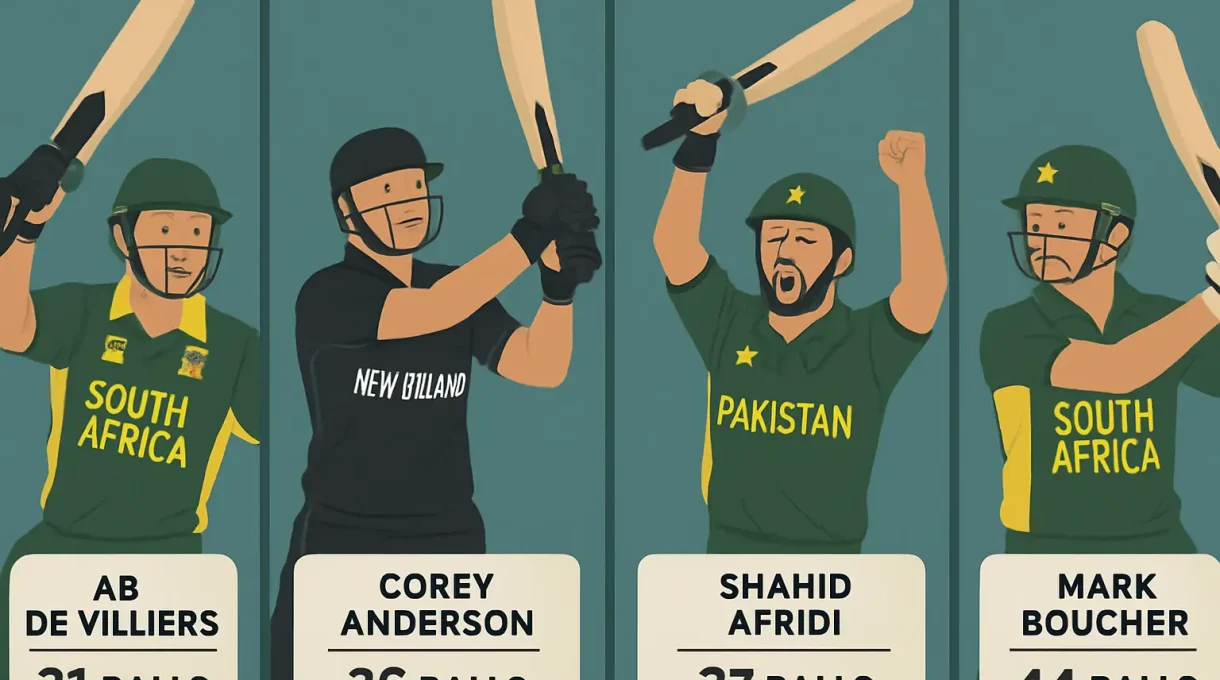
AB de Villiers owns the fastest century in ODI history — a jaw dropping hundred off 31 balls — the modern benchmark for power-hitting, audacity, and pure tempo control. The number looks unreal because it is the outlier that reset how limited-overs batting is imagined. Since that day, every lightning start, every violent middle-overs spell, every finisher’s cameo is inevitably measured against that 31-ball supernova.
This is the definitive, expert-led deep dive into the fastest century in ODI cricket, the complete list of the quickest hundreds by balls, the fastest ODI century in World Cups, country-wise record holders, and the tactical anatomy of sub 50-ball tons. It blends hard data with batting strategy, match context, and the kind of dressing-room detail you only pick up by watching patterns across eras, venues, and roles.
Fastest ODI century record at a glance
- Record holder: AB de Villiers
- Balls to reach hundred: 31
- Team: South Africa
- Opposition: West Indies
- Context: Platform set by a monster opening stand, high altitude, white-ball flying at the Wanderers, and a hitter who never missed the length
Why balls faced is the gold standard
The fastest hundred in ODI cricket is judged by balls faced because tempo is the essence of the feat. Strike rate, run rate, or over number can be skewed by rain breaks, fielding restrictions, and game length. Balls faced normalizes those variables and isolates how quickly a batter converts deliveries into damage.
Where tie-breakers are needed for the list, the order follows:
- Fewer balls faced to reach the hundred is the primary sort
- If equal, the player who reached fifty in fewer balls ranks higher
- If still equal, the earlier achievement by chronology ranks first
Top 10 fastest hundreds in ODI history
The table below lists the fastest ODI centuries by balls faced. It prioritizes clarity over noise and highlights batting role and innings context, because a sub 50 ball ton while finishing is a different problem to solve than a sub 50 as an opener with two new balls.
| Balls | Player | Team | Opposition | Batting role | Innings context |
|---|---|---|---|---|---|
| 31 | AB de Villiers | South Africa | West Indies | Middle order | Setting a total |
| 36 | Corey Anderson | New Zealand | West Indies | Middle order | Setting a total in a rain-shortened game |
| 37 | Shahid Afridi | Pakistan | Sri Lanka | Opener | Setting a total |
| 40 | Glenn Maxwell | Australia | Netherlands | Middle order | World Cup, setting a total |
| 41 | Asif Khan | United Arab Emirates | Nepal | Middle order | Setting a total |
| 44 | Mark Boucher | South Africa | Zimbabwe | Middle order | Setting a total |
| 45 | Brian Lara | West Indies | Bangladesh | Top order | Setting a total |
| 45 | Shahid Afridi | Pakistan | India | Opener | Chasing |
| 46 | Jesse Ryder | New Zealand | West Indies | Opener | Setting a total |
| 46 | Jos Buttler | England | Pakistan | Middle order | Chasing |
Notes and context that elevate numbers into stories
AB de Villiers, 31 balls
The fastest ODI century record belongs to a hitter built for chaos and control in the same breath. The altitude at Johannesburg helps the ball travel, but that alone does not explain a 31-ball hundred. The platform in front allowed de Villiers to attack from ball one. He hit to every inch of the field — conventional lofted drives, baseball-flat swats over midwicket, ramps over the keeper, the occasional reverse option to maul the shorter boundary. Bowlers lost their yorker on length changes, spinners lost their field, and the square boundaries looked a club net. The white-ball did not swing, the outfield ran quick, and de Villiers punished anything length or wider than a stump.
Corey Anderson, 36 balls
A rain-trimmed game in Queenstown supercharged intent. The innings was short enough that bowling units had minimal time to adjust fields, and power-hitters like Anderson could swing hard with fewer consequences. He cleared straight boundaries with a stable base and massive leverage. Field restrictions combined with the certainty of a short innings created permission for risk. The result was a clean, fast-motion tutorial on front-foot power against pace-off and back-of-a-length.
Shahid Afridi, 37 and 45 balls
The pioneer of lawless ODI acceleration. In Nairobi, he opened and teed off with that signature heavy-bat arc, backlift to the clouds, hands through the line, and wrists snapping the ball into the next neighbourhood. The century off 37 balls smashed expectations of what the first powerplay could look like. The 45-ball ton in a chase, in a hostile subcontinental cauldron, came with even more pressure — fields set for wickets, premium bowlers on, and no cushion. Afridi kept hitting straight and with the spin from ball one, forcing captains to deploy boundary riders where gaps already existed.
Glenn Maxwell, 40 balls
A World Cup day when the switch-hit felt like a stock stroke and the reverse sweep against pace looked routine. Maxwell’s genius lies in manipulating fielders and angles more than brute force alone. He used the crease, stepped across early, and had both the inside-out loft and the slog-sweep on a string. With the ball skidding on in Delhi, he made even length balls disappear square and straight. That hundred at the tournament level does more than set a record. It applies psychological pressure on every opponent scanning that wagon wheel in their pre-game.
Asif Khan, 41 balls
Associate cricket keeps dropping gems that punch above narrative weight. A 41-ball hundred from the UAE’s middle order featured clean leg-side leverage, quick pick-up on length, and no fear of going aerial down the ground. Matches in the League ecosystem can produce short, sharp accelerations when surfaces are flat and boundary sizes modest. Asif Khan cashed every one of those conditions with a technique that looks built for the modern ODI.
Mark Boucher, 44 balls
A wicketkeeper-finisher known for game awareness rather than flamboyance, Boucher’s 44-ball hundred was a masterclass in picking the right ball to hit. He waited for width, trusted his base on lofted strokes, and drove spin hard with long levers. The pace of the innings owed as much to shot selection as raw power — a clinical demolition with a spreadsheet’s discipline.
Brian Lara, 45 balls
Timing, wristwork, and that languid backlift. Lara’s 45-ball ton distilled his Test match elegance into ODI acceleration. Short on the legs disappeared. Anything back of a length through cover or midwicket became a blur. He created gaps where none existed by manipulating late — the sort of batting that demoralizes bowlers because good balls go for four anyway.
Jesse Ryder, 46 balls
A left-handed opener with bat speed to burn, Ryder’s fastest hundred came with the new ball but without caution. He drove on the up, cut anything short, and punished width. On flat New Zealand surfaces, he rode bounce, held shape, and hit through the line repeatedly.
Jos Buttler, 46 balls
Buttler’s condensed fury as a finisher is defined by late decision-making and serious bat speed. On a used surface in Dubai, he got low to sweep seamers, accessed cow corner with that helicopter release, and ran hard to squeeze an extra ball per over in the bowler’s mind. The hundred arrived without slog. It came through repeatable, practiced chaos, where every option is trained and every field has a counter.
The anatomy of a 30–40-ball ODI hundred
- Launchpad matters: The fastest hundreds often arrive off a platform or in shortened innings. When the top order gives a base, middle-order hitters can assault from ball one. In shortened games, every powerplay ball feels like a free swing, and bowlers rarely get their rhythm.
- Boundary percentage and strike density: The ratio of boundaries to balls faced dictates feasibility. A sub 40 ball hundred demands a boundary or better roughly once every other ball for extended spells. That implies ruthless targeting of zones — full and wide to open the off side, length onto the practice pitch at midwicket, and anything short sent square.
- Match-ups over method: The modern finisher banks match-up data. Off-cutters into the pitch get swept, hard length gets picked up with a strong bottom hand, and anything fuller risks the straight hit. Free hits, field restrictions, and knowing which overs a captain must burn from a fifth bowler create windows to jump the tempo.
- Skill stack, not slog: Ramp, reverse, switch, conventional drive. The fastest ODI century record holders layer improvisation on top of mechanics. Hips clear early, head stays still, base remains stable, and wrists finish the job.
- Venue and conditions: Altitude inflates value. Dry outfields race. White-ball seams go soft quickly under lights. Some grounds slide on at night. Every top-10 effort married intent with a venue that rewarded clean hitting.
Fastest ODI century in World Cups
Glenn Maxwell’s 40-ball rocket is the World Cup benchmark. It landed amid high tournament pressure, on a stage where captains are better prepared and bowling attacks deeper. Aiden Markram’s 49-ball burst, another tournament high, underlined how modern middle orders are programmed to exit the middle overs with a death-overs mindset if conditions allow. Kevin O’Brien’s extraordinary 50-ball hundred in a famous chase remains one of the great tournament shocks, and a reminder that pressure is a performance amplifier for the fearless.
Fastest ODI centuries at the Cricket World Cup
| Balls | Player | Team | Opposition | Role | Context |
|---|---|---|---|---|---|
| 40 | Glenn Maxwell | Australia | Netherlands | Middle order | Setting a total in a tournament match |
| 49 | Aiden Markram | South Africa | Sri Lanka | Middle order | Setting a total in a tournament match |
| 50 | Kevin O’Brien | Ireland | England | Middle order | Chasing in a tournament match |
What separates World Cup fast hundreds from bilateral fireworks
- Analysis depth: Teams hunt match-ups ruthlessly, so to outpace them requires premeditated counters and an expanded stroke library.
- Stage pressure: Boundaries carry more meaning and bowlers hold their nerve longer, so batters must sustain intent for longer windows.
- Conditions: Tournament schedules produce mixed surfaces. The fastest tournament hundreds tended to arrive on surfaces with true bounce and quick outfields, often at venues with square boundaries in play.
Fastest ODI century while chasing
The fastest ODI century in a chase belongs to Shahid Afridi at 45 balls, an achievement with an extra layer of difficulty. Chasing demands scoreboard respect. Fielding sides set attacking fields, premium bowlers take the new ball with fresh intent, and a misstep early can lose the game. To sustain a sub 50 tempo under pursuit, a batter must hit the best balls, not simply punish the worst. Two other chasing landmarks routinely cited by analysts in tempo studies are Jos Buttler’s 46-ball cleanout against a high-class attack and Virat Kohli’s 52-ball hurricane in a big chase, both masterclasses in reading fields and extracting two boundaries per over even when the ball is not in the slot.
Fastest ODI century by country
National record holders reflect both style and identity. Some sides bred openers who went hard from ball one. Others raised finishers who compress death overs into mini-explosions. The headline fastest hundred in ODI cricket by leading nations:
- South Africa — AB de Villiers, 31 balls
- Australia — Glenn Maxwell, 40 balls
- New Zealand — Corey Anderson, 36 balls
- Pakistan — Shahid Afridi, 37 balls
- India — Virat Kohli, 52 balls
- England — Jos Buttler, 46 balls
- Sri Lanka — Sanath Jayasuriya, 48 balls
- West Indies — Brian Lara, 45 balls
- Bangladesh — Shakib Al Hasan, 63 balls
- Afghanistan — Mohammad Shahzad, 88 balls
- Ireland — Kevin O’Brien, 50 balls
- United Arab Emirates — Asif Khan, 41 balls
Country patterns that jump out
- South Africa and Australia lead with middle-order firepower, a nod to a finishing culture that values 360-degree options and bat swing late.
- Pakistan’s record starts at the top through Afridi’s opener belligerence, with a legacy that inspired later pinch hitters.
- India’s fastest sits in a chase, consistent with a national template that values calculated pursuit, field reading, and dead-straight hitting.
- New Zealand’s fastest emerged from a condensed game, a feather in the cap for tempo specialists who exploit revised conditions better than most.
Related ODI acceleration records that complete the picture
- Fastest fifty in ODI: AB de Villiers reached fifty in 16 balls, a rate that compresses decision time for bowlers and forces captains into defensive fields by the powerplay’s middle.
- Fastest 150 in ODI: AB de Villiers again, converting to 150 in a blur, a perfect case study in how to maintain shape even when swinging hardest.
- Fastest 200 in ODI: Ishan Kishan’s double remains the quickest to that milestone by balls faced, a modern opener’s template of high-gear tempo and relentless boundary access.
- Highest strike rate in a big ODI innings: The heavy-hitting elite who own the fastest ODI century marks often dominate this category in individual knocks, with boundary percentage north of fifty and strike rates well above 250 during the charge.
- Most sixes in an ODI innings: The short list is packed with names in the fastest hundreds club, since sustained six-hitting is the only reliable way to achieve sub 40-ball tons.
How fastest ODI centuries really happen
- Platform and permission
A 31-ball hundred does not arrive in isolation. Teams build scenarios to enable destruction. A no-loss powerplay. A 15-over anchor glide at run-a-ball. The set batter defers death-overs ownership to a specialist. This is planned tempo architecture, not a coin flip. - Windows of overmatch
Every innings has windows where the hitter outranks the bowler. Fifth bowler overs. New spell sighters. Cross-breeze when defending the short side. Mental fatigue when the seamers return without the same snap. Elite hitters know when to spend their risk tokens. - The three-stroke rule
Fastest-hundred candidates typically show three low-error boundary options they can recycle on demand- A straight hit to anything full within the stump line
- A slog-sweep or pick-up to take length off into the leg-side pockets
- A late glide, ramp, or open-face slice to beat third or fine
With three money shots, bowlers cannot protect all zones at once. That is how a batting card jumps from 10 off 6 to 40 off 14 to 84 off 28.
- Tempo mapping over narrative rhythm
Great finishers are insensitive to optics. They are perfectly happy to face six balls in a row if the match-up is theirs, or to take a single on ball one when plans say stretch the over to extract a poor last ball. The graph they chase is expected runs per ball, not highlight-reel cadence. - Field reading in real time
When square goes out, the best hitters do not swing harder. They switch horizons. Good length turns to scoop length. Wide yorker becomes the carve between point and cover with an open blade. Captains who move the wrong rider get punished within two balls.
Venues and conditions that turbocharge the fastest ODI century
- Altitude aids: High-altitude venues enhance carry, as seen at the Wanderers. Slight mishits clear inner rings. Full contact exits the stadium. Fielders backpedal earlier, converts twos into uncatchables.
- Outfield speed: Dry, trimmed squares mean ground strokes outrun fielders. A classical cover drive can match a mistimed slog for value, keeping the strike rotating so the set hitter faces more balls.
- White-ball behaviour: Two new balls keep hardness longer for both ends early on, but in the final overs the slightly scuffed ball often skids on. Slower balls sit up if the surface grips, but on truer pitches they become hit-me pace-off deliveries if the batter waits deep.
- Boundary geometry: Grounds with asymmetric squares create hitting plans. Switch-hitters play to the short side. Right-handers pick lengths that enable pickup to cow corner. Bowlers who miss to the short side under pressure pay with compound interest.
Batting position insights from the fastest hundred in ODI lists
- Openers with license: Afridi’s 37-ball special at the very top underlines what an opener with permission can do if the risk bar is raised. New ball pace, only two men out, anything in the slot looks enormous.
- Middle-order masters: De Villiers, Maxwell, Anderson, Buttler — the modern finishing school. They arrive with a job already set, pack five overs of reconnaissance into three balls, then detonate. Their practice is different. Range-hitting sessions target ramps, pick-up slog, and open-face lofts. When they find the one over to start, they rarely stop.
- The No. 5 and No. 6 sweet spot: A surprisingly high share of sub 45-ball centuries live here. Enough balls left to build, enough fielders deep to exploit angles, enough overs of weaker match-ups, and full permission to take risk because a set hitter behind can still go.
Game plans that repeatedly deliver sub 50 ODI tons
- Over-based targets, not bowler-based grudges: Hitters set a minimum of two boundaries per over in the assault phase. If the first two balls do not yield one, the third and fourth are pre-planned for risk. If the fifth goes for a single, the sixth is designated max effort. This turns random hitting into structured carnage.
- Boundary or better on ball one: The early-over punch does more than add four runs. It sends the field back, ruins the bowler’s next ball, and improves the odds that the fifth and sixth balls become sitters.
- Rotating to the striker’s arc: Batters are fussy about ends, breeze, and angles. If the non-striker has the wrong match-up, he takes the single on ball one to reset. It looks unselfish. It is calculated.
- Invisible fitness: These innings look like pure boundary theatre, but the running matters. A sprint double after a mistimed swat brings the striker back for another swing. Ten extra balls faced at 250 strike rate is 25 extra runs. That changes record pace.
Fastest ODI century India lens
India’s fastest ODI century is a 52-ball blaze from Virat Kohli in a chase, textbook modern pursuit built on reading fields early, targeting the right bowlers, and staying dead straight off anything full. Indian batting culture values calculated aggression, so the real trick is not the isolated boundary but the relentlessness of pressure over ten overs. Rohit Sharma’s tempo surges, Hardik Pandya’s finishing muscle, and Ishan Kishan’s powerplay bravado have all flirted with the sub 50 horizon, but Kohli’s benchmark remains the high-water line for pace plus control in the blue.
Fastest ODI century Pakistan lens
Pakistan’s record is the wild-born template. Shahid Afridi’s 37-ball classic at the top and the 45-ball chase-fire are the twin spires of aggressive ODI DNA. The follow-on effect blessed a later generation with fearlessness around risk. With emerging hitters who view 120 strike rate as a starting point, the idea of another sub 40 is never far away when surfaces are flat.
Fastest ODI century Australia lens
Glenn Maxwell’s 40-ball World Cup record is the apotheosis of Australian white-ball evolution — all options on the table, no fear of losing shape while trying the unorthodox, and an obsession with scoring off the last ball of the over. The Australian finishing school prizes range-hitting repetition and bat speed. Maxwell’s role distilled that into a record that will stalk every future campaign.
Fastest ODI century South Africa lens
South Africa’s makes a statement about skill density. AB de Villiers’ 31-ball freakshow sits alongside a tradition of hard-hitting wicketkeepers and middle-order cruisers who can turn a run-a-ball start into over-overkill. With hitters who split the field in 360 degrees, South Africa consistently creates conditions where records can be threatened.
Fastest ODI century England lens
Jos Buttler’s 46-ball mayhem redefined finishing on slow decks. England’s white-ball reboot produced batters trained to treat even good-length as hittable with the right release. Reverse ramps against pace, baseball-style pulls to balls into the pitch, and extreme hand speed produced a chasing blueprint that travels.
Fastest ODI century Sri Lanka lens
Sanath Jayasuriya’s 48-ball record was the prototype pinch-hitting era. Third-man up, fielders on the ring, and the first ten overs suddenly became a sprint. Sri Lanka’s heritage of gifted strokemakers married intent with finesse and showed the world how much the first powerplay could matter.
Fastest ODI century New Zealand lens
Corey Anderson’s 36-ball record amplified a national emphasis on role clarity. New Zealand sides often task a designated hitter with over-acceleration the moment conditions allow. When the top order supplies a base, they attack relentlessly, trusting the bowling unit to defend even par-plus scores.
Fastest ODI century West Indies lens
Brian Lara’s 45-ball masterpiece fits the Caribbean’s lineage of effortless power and wrists that defy geometry. Later generations added brutal straight hitting, but Lara’s record remains a reminder that timing and placement can match bat speed for speed scoring.
Fastest ODI century Bangladesh and Afghanistan lens
Bangladesh’s fastest ODI century benchmark belongs to Shakib Al Hasan, an all-rounder who blends touch with opportunism, turning even conservative surfaces into platforms for accelerations. Afghanistan’s quickest sits with Mohammad Shahzad, a trailblazer for associate-turned-full member aggression who treated spin and seam with the same dismissive swing. Both nations built their white-ball identities on adaptability, and their records track a steady rise in tempo across the order.
Chasing versus setting: what the data whispers
- Setting totals unleashes chaos: With no ceiling, middle-order hitters know an extra thirty runs in four overs can turn the game. Risk appetite climbs. Fielding captains experiment with fifth-bowler overs. Result — breeding ground for sub 45.
- Chasing raises the bar for quality: The fastest ODI century while chasing must beat premium spells when wickets are the currency and captains hold back best overs for the kill. Risk still lives, but timing those risks becomes everything. Afridi’s 45 and Buttler’s 46 speak to a brutal willingness to beat length aimed to get them out.
- Powerplay value without fever: Even in the fastest centuries, many hitters started at a run-a-ball for eight to ten deliveries, then jumped. That early sighter phase sets the later explosion. It looks like madness only when viewed without the first ten balls.
What separates a record day from a good day
- A bowler in the wrong role bowls a key over at the wrong time
- An extra cover fielder placed five metres too square
- A slower ball with tell — grip revealed early, seam position readable
- Two misfields that turn ones into twos and hand the striker back to the destroyer
- A short side boundary in play with a cross-breeze
- One dropped catch early that costs twenty extra balls faced by the same batter
These micro-edges compound. The fastest ODI century list is a monument to small decisions exploited without mercy.
How we validate this list and keep it fresh
- Primary data sources: ESPNcricinfo records and Statsguru filters for balls faced, innings context, batting position, and opposition. Cross-verification with ICC record pages and Wisden match reports where available.
- Match-level logs: Each entry is tied back to scorecards and over-by-over commentary to confirm balls to fifty and balls to one hundred, which acts as the tie-breaker criterion when needed.
- Tie-break policy: Same balls to hundred leads to the player with the faster fifty ranking higher; if still tied, earliest achievement listed first.
- Filters and breakouts: By batting position, innings (first or chase), tournament vs bilateral, and country.
- Update rhythm: Ongoing ODIs are monitored and the table is refreshed within a tight window once an innings is complete and verified. The target is rapid accuracy with complete context, not just a number.
- Last updated: this week
Why this page goes beyond a list
The fastest century in ODI cricket is not just a statistic. It is an insight into how the format keeps evolving. Two new balls from either end changed the value of opening risk. Bigger bats and fitter outfielders altered singles into twos and kept strike in the right hands. Coaches built finishing programs that prioritize bat speed and angle creation without sacrificing basics. Analysts now code match-ups more deeply, which is why destruction often arrives in precise five-over pockets rather than as vague momentum.
Modern ODI batting is a conversation between risk tolerance and shot repeatability. The record holders in this space are not gamblers. They are engineers. They decide which balls they are allowed to hit out of the ground before they walk in. They train the muscle memory for those balls. Then they trust it.
Key takeaways that help decode future record threats
- The next 30 something ball hundred likely comes from a middle-order hitter in a game with a perfect platform, possibly in a shortened innings on a fast ground, with two overs of fifth-bowler inventory to exploit.
- World Cup records get harder, not easier, because scouting improves. Maxwell’s 40-ball landmark stands taller for that reason.
- Country-wise, South Africa and Australia continue to produce the world’s most complete finishers. Pakistan’s best route to another record runs through an opener with license and a perfect morning surface. India’s template relies on a pursuit with one long spell of domination in overs 11–20, then a finishing kick. England’s best shot is a Buttler-class finisher on a true deck with short square.
- For associates and emerging teams, shorter boundaries and League structures create opportunities. Asif Khan’s 41 is not an outlier in ambition. It is a signal that the power game is global.
The live spirit of the list
The beauty of this record is that it is a living thing. ODI cricket breathes in cycles, and every cycle throws up a batter who redefines the ceiling. The fastest hundred in ODI history will always be an audacious mark, a dare to the next hitter who thinks risk is a friend, not a foe. Some days the format bends to that belief. When it does, the numbers look like fiction, the crowd becomes a roar that never dims, and the scorecard, hours later, still hums with the shock of it.
Appendix: Clean reference summaries
Top 10 fastest ODI centuries by balls faced
- AB de Villiers — 31 balls
- Corey Anderson — 36 balls
- Shahid Afridi — 37 balls
- Glenn Maxwell — 40 balls
- Asif Khan — 41 balls
- Mark Boucher — 44 balls
- Brian Lara — 45 balls
- Shahid Afridi — 45 balls
- Jesse Ryder — 46 balls
- Jos Buttler — 46 balls
Fastest ODI century in World Cups
- Glenn Maxwell — 40 balls
- Aiden Markram — 49 balls
- Kevin O’Brien — 50 balls
Country record snapshots
- South Africa — AB de Villiers, 31
- Australia — Glenn Maxwell, 40
- New Zealand — Corey Anderson, 36
- Pakistan — Shahid Afridi, 37
- India — Virat Kohli, 52
- England — Jos Buttler, 46
- Sri Lanka — Sanath Jayasuriya, 48
- West Indies — Brian Lara, 45
- Bangladesh — Shakib Al Hasan, 63
- Afghanistan — Mohammad Shahzad, 88
- Ireland — Kevin O’Brien, 50
- United Arab Emirates — Asif Khan, 41
Closing thought
The fastest ODI century is where physics meets nerve. It is a graph of intent rising into thin air, a collage of mislengths harvested without sympathy, and a tutorial in how to bend a format to your will. As long as ODI cricket keeps its room for imagination, someone will look at 31 balls and feel not fear but invitation. When that day arrives, the record will not be broken by accident. It will be built stroke by stroke, over by over, with a plan so aggressive it reads like prophecy. Until then, AB de Villiers’ 31-ball thunderclap remains the mountain everyone else climbs in their dreams.